Best HWID Spoofer in 2026 for Getting Unbanned From Any Game Fast
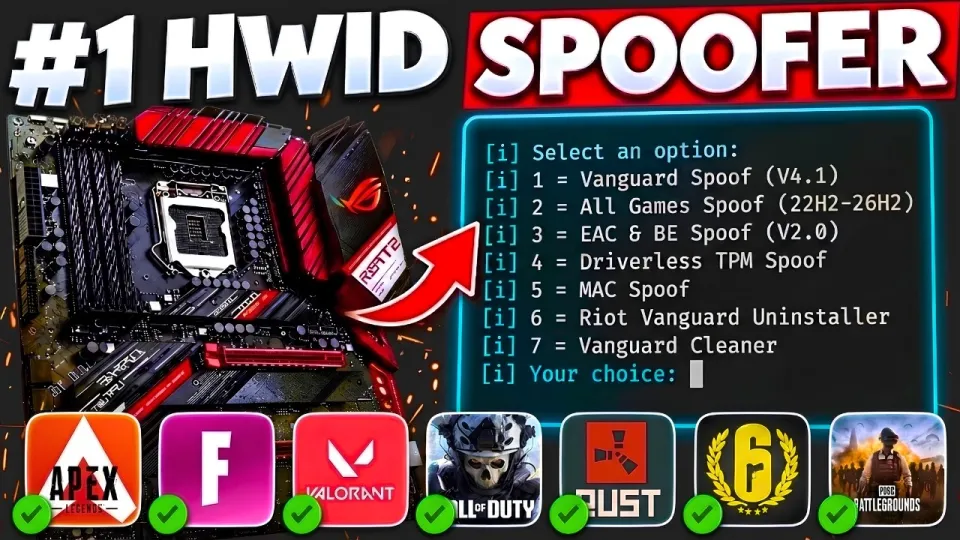
Video: HWID Spoofer Full Guide: How To Get Unbanned From Any Game Fast! (Best HWID Spoofer)
· based on the channel 芸芸记录生活
Key takeaways
- A hardware ID (HWID) ban blocks the physical components of a PC, not just the game account, so a new account alone does not lift it.
- Zaliant's permanent spoofer is sold at $zaliantservices.com and includes a TPM bypass aimed specifically at Valorant hardware bans.
- The tool claims support for all motherboards and does not require a Windows reinstall or reset.
- The vendor reports 3000+ customers and covers bans in Valorant, Fortnite, Rust, Call of Duty, Apex Legends and FiveM.
- Setup is a download, run and reboot cycle; the video shows a real unban result within roughly a minute of use.
The best HWID spoofer in 2026 is a tool that changes the hardware identifiers a game's anti-cheat reads, so a banned machine looks like a new one without reinstalling Windows. The most direct option covered here is the permanent HWID spoofer from Zaliant Services, which bundles a TPM bypass for Valorant bans, claims support for all motherboards and requires no Windows reset.
A hardware ban is not the same as an account ban. When Valorant, Fortnite, Rust, Call of Duty or Apex Legends flags a machine, the anti-cheat fingerprints components such as the motherboard, disk serials, SMBIOS strings, MAC addresses and, on newer systems, the TPM module. A fresh account on the same PC gets flagged again within minutes, which is why players search for a hardware ID spoofer rather than another key.
How an HWID spoofer actually lifts a hardware ban
An HWID spoofer works by intercepting or rewriting the identifiers that anti-cheat software collects during a scan, so the ban list no longer matches the machine. The typical targets are:
- Motherboard and BIOS identifiers, including SMBIOS and system UUID values.
- Disk and volume serial numbers on every drive, including secondary and external disks.
- Network adapter MAC addresses and related registry entries.
- Windows installation and product identifiers tied to the machine.
- TPM and secure-boot data, which Riot's Vanguard reads closely on Valorant bans.
A permanent spoofer applies these changes at the driver or boot level so they survive reboots. A temporary spoofer only masks values for the current session, which is why most players who get banned repeatedly move to a permanent solution. The practical difference shows up after a Windows update or a driver reinstall: a permanent spoof holds, a session-based one usually does not.
What the Zaliant permanent spoofer includes
The Zaliant package is positioned as an undetected HWID spoofer for 2026 with a TPM bypass built in for Valorant. According to the vendor, the key features are:
- TPM bypass included, aimed at Valorant hardware bans where Vanguard checks the trusted platform module.
- Support for all motherboards, so the tool is not limited to one chipset or vendor.
- No Windows reset or reinstall required, which saves hours compared with manual methods.
- Coverage across Valorant, Fortnite, Rust, Call of Duty, Apex Legends and FiveM.
- Constant updates and support through a dedicated Discord community.
- A reported 3000+ satisfied customers.
The product is sold as a one-time permanent license through the vendor's store, and access plus support run through the Zaliant Discord server. Buyers should treat any spoofer purchase as a risk decision: anti-cheat vendors actively detect spoofing drivers, and a detection can mean a new ban on the freshly spoofed machine.
Step-by-step: using a spoofer to get back into a game
The process shown in the guide is short, but the order matters because anti-cheat services start at boot. A safe sequence looks like this:
- Purchase and download the spoofer from the vendor page, and keep the license key and Discord invite handy.
- Close the game and its launcher completely, including background services such as Vanguard, Easy Anti-Cheat or BattlEye.
- Run the spoofer as administrator and let it apply the hardware changes.
- Reboot the PC so the new identifiers load before any anti-cheat driver starts.
- Create a new game account with a clean email, and avoid reusing the same payment method or phone number as the banned account.
- Launch the game and verify that a match loads normally.
Skipping the reboot is the most common mistake. If the anti-cheat driver loads before the spoofed values are active, the machine can be flagged again with the old fingerprint. The same applies to reinstalling the game on the same drive without re-running the spoofer after a major Windows update.
Which bans a spoofer can and cannot fix
An HWID spoofer addresses machine-level bans, not account-level punishments. It can help when the ban message references hardware, when a new account is banned within minutes, or when the player has been caught in a wave ban across multiple accounts on one PC. It cannot restore a banned account, remove a permanent game ban from a Riot or Epic account, or undo a payment or chargeback block tied to a person rather than a device.
There are also limits worth knowing before buying. Some games combine hardware fingerprints with behavioral and network signals, so a spoofed machine can still be flagged if the player repeats the same pattern. Server-side checks on newer anti-cheat builds occasionally re-validate values mid-session, which is why vendors ship updates continuously. And on Valorant specifically, the TPM requirement introduced with Windows 11 means a spoof without TPM handling often fails on the first launch.
Free spoofers versus paid permanent spoofers
Free HWID spoofers circulate widely on forums and YouTube comments, and most of them are either outdated, detected or outright malware. A free tool that edits registry keys by hand can work for a single game for a few days, but it rarely covers TPM data, disk serials across all drives, or the SMBIOS layer that modern anti-cheat reads. Paid permanent spoofers cost money and carry their own detection risk, but they typically include updates, a support channel and a driver signed well enough to load on current Windows builds.
The realistic trade-off is this: free tools are fine for testing whether a hardware ban is really the problem, and paid tools are what people buy once they have confirmed it is. Either way, never run a spoofer from an unknown archive on a machine you use for banking or work.
All links from the guide
- Permanent HWID spoofer product page: https://www.zaliantservices.com/products/permanentspoofer
- Zaliant store: https://www.zaliantservices.com
- Zaliant Discord community: https://discord.gg/zaliant
Final take on the best HWID spoofer for 2026
A hardware ban is solvable at the machine level, and the Zaliant permanent spoofer is the tool this breakdown centers on, with TPM bypass, all-motherboard support and no Windows reset. The steps are simple, but the details decide the outcome: close the anti-cheat first, spoof, reboot, then create a clean account. Buy only through the official product page, keep the Discord for updates, and accept that no spoofer is permanently undetected. The video walkthrough on the channel 芸芸记录生活 shows the full purchase-to-unban flow, including a real unban result. To get started, grab the permanent spoofer license and follow the reboot order exactly.
Source: HWID Spoofer Full Guide: How To Get Unbanned From Any Game Fast! (Best HWID Spoofer) · Markdown version
Questions & answers
Does an HWID spoofer really unban a game account?
No. A spoofer changes the hardware identifiers of your PC so the machine is no longer on the ban list; the banned account stays banned. You still need a new game account, and you should use a clean email and payment method to avoid linking it to the old one.
Why is a TPM bypass needed for Valorant?
Vanguard, Riot's anti-cheat, reads TPM and secure-boot data as part of its hardware fingerprint on Windows 11 systems. Without handling that layer, a spoofed machine can still match the original ban, so spoofers aimed at Valorant include a TPM bypass.
Do I have to reinstall Windows after using a spoofer?
Not with a permanent spoofer that applies changes at the driver or boot level. A reboot is required so the new identifiers load before the anti-cheat starts, but a full Windows reset is unnecessary and is one of the main selling points of paid tools.
Are free HWID spoofers safe to use?
Most free spoofers are outdated, quickly detected, or bundled with malware, and they rarely cover TPM data or disk serials on every drive. They can be useful to confirm that a hardware ban is the issue, but for a lasting fix players generally move to a paid tool with updates and support.